
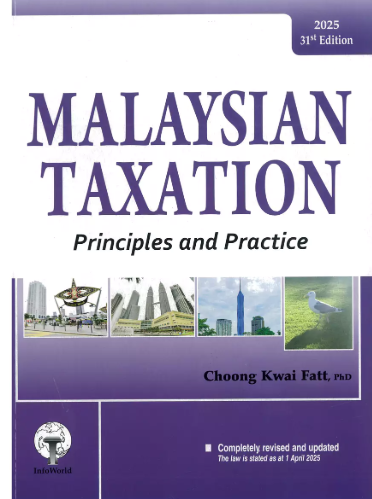
Course Description:
Taxation EBA2153 (Malaysian Taxation) introduces Year 2 undergraduate students to the core principles, framework, and practical applications of the Malaysian income tax system governed by the Income Tax Act 1967 (Act 53/1967). The course provides a foundation in tax law, tax administration, and the principles that determine income tax liability for individuals and corporate entities. Students will explore key concepts such as the scope of charge, the distinction between capital and revenue receipts, residence status, and how to compute chargeable income across various income sources.
Key Learning Topics:
1. Scope of Charge & Classes of Income
2. Residence Status:
3. Employment Income
4. Investment & Other Income Sources
5. Business Income & Allowable Expenses
6. Capital Allowances & Industrial Building Allowances
7. Tax Computations & Framework
Welcome to Taxation EBA2153!
This semester, we are integrating Artificial Intelligence (AI) into our course as a supportive learning assistant to enrich your academic journey and deepen your understanding of Malaysian Taxation.
1. AI as Your Personal Tutor, Not Your Instructor.
Think of AI as a 24/7 teaching assistant, tutor, or study partner.
You can use it to:
a. Clarify concepts: Ask it to break down complex topics, such as the Scope of Charge (Section 3) or the Wholly and Exclusively test for business expenses (Section 33).
b. Study and test yourself: Request practice questions on individual residence status (Section 7) or the calculation of employment benefits-in-kind.
c. Brainstorm & structure: Get help outlining your study guides, summarizing case law principles, or drafting schedules for tax computations.
2. Verify and Cross-Check All AI Outputs
While AI is a powerful tool, it is not an instructor and is not foolproof. Tax law demands absolute accuracy, strict statutory compliance, and correct application of case law. Therefore:
a. Check the reliability: AI models can sometimes generate plausible-sounding but incorrect information or cite outdated tax rates.
b. Verify against official sources: Always cross-reference AI-generated answers, formulas, and tax treatments with the Income Tax Act 1967, Public Rulings issued by the Inland Revenue Board (HASiL), recommended course textbooks, and lecture slides.
c. Take ownership: You are ultimately responsible for the work you submit and the accuracy of the tax knowledge you demonstrate in assessments.
Used responsibly, AI will be a fantastic partner in helping you master Malaysian Taxation this semester.
Taxation EBA2153 (Malaysian Taxation) introduces Year 2 undergraduate students to the core principles, framework, and practical applications of the Malaysian income tax system governed by the Income Tax Act 1967 (Act 53/1967). The course provides a foundation in tax law, tax administration, and the principles that determine income tax liability for individuals and corporate entities. Students will explore key concepts such as the scope of charge, the distinction between capital and revenue receipts, residence status, and how to compute chargeable income across various income sources.
Key Learning Topics:
1. Scope of Charge & Classes of Income
2. Residence Status:
3. Employment Income
4. Investment & Other Income Sources
5. Business Income & Allowable Expenses
6. Capital Allowances & Industrial Building Allowances
7. Tax Computations & Framework
Welcome to Taxation EBA2153!
This semester, we are integrating Artificial Intelligence (AI) into our course as a supportive learning assistant to enrich your academic journey and deepen your understanding of Malaysian Taxation.
1. AI as Your Personal Tutor, Not Your Instructor.
Think of AI as a 24/7 teaching assistant, tutor, or study partner.
You can use it to:
a. Clarify concepts: Ask it to break down complex topics, such as the Scope of Charge (Section 3) or the Wholly and Exclusively test for business expenses (Section 33).
b. Study and test yourself: Request practice questions on individual residence status (Section 7) or the calculation of employment benefits-in-kind.
c. Brainstorm & structure: Get help outlining your study guides, summarizing case law principles, or drafting schedules for tax computations.
2. Verify and Cross-Check All AI Outputs
While AI is a powerful tool, it is not an instructor and is not foolproof. Tax law demands absolute accuracy, strict statutory compliance, and correct application of case law. Therefore:
a. Check the reliability: AI models can sometimes generate plausible-sounding but incorrect information or cite outdated tax rates.
b. Verify against official sources: Always cross-reference AI-generated answers, formulas, and tax treatments with the Income Tax Act 1967, Public Rulings issued by the Inland Revenue Board (HASiL), recommended course textbooks, and lecture slides.
c. Take ownership: You are ultimately responsible for the work you submit and the accuracy of the tax knowledge you demonstrate in assessments.
Used responsibly, AI will be a fantastic partner in helping you master Malaysian Taxation this semester.
- Teacher: Keria Bin Kontot