- Teacher: Faridah binti Sahari
eLEAP
Search results: 19

- Teacher: Natasha binti Rusdy Wong

- Teacher: Marzie Hatef Jalil

- Teacher: Natasha binti Rusdy Wong

- Teacher: Sylvester Wielding Jussem
- Teacher: Natasha binti Rusdy Wong

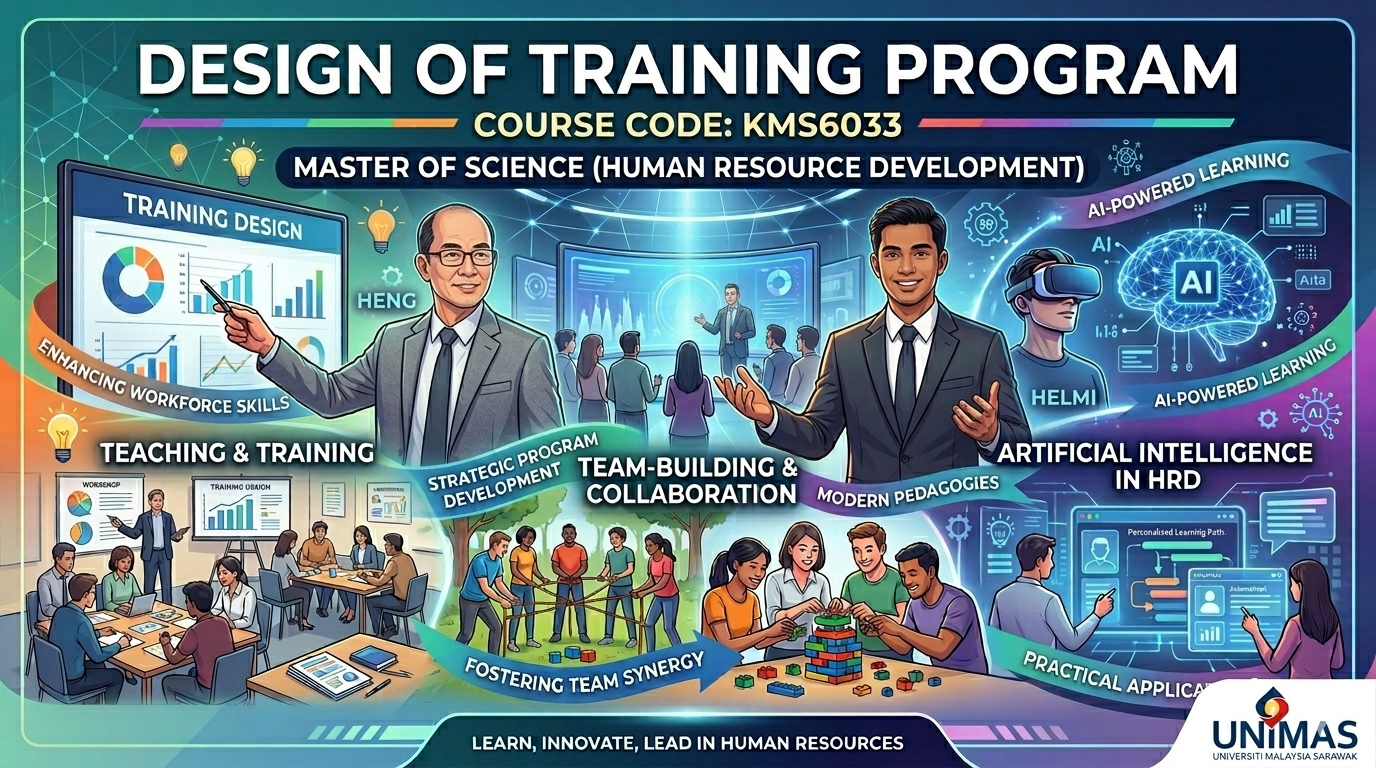
Training and developing human resources will determine the success of an organization. Training programs must be carefully designed and managed to meet the needs of the organization and the people in it. This course introduces the concept of training and development, and the principles and guidelines for the design and management of effective training programs. Topics to be discussed include an overview of training and development, ways of identifying training needs, formulation of training objectives, effective teaching and learning strategies, development of the curriculum, methods of training, management of training location and resources, training administration, and evaluation of training programs. It also looks at some organizational factors affecting training and development.
- Teacher: Helmi bin Sumilan
- Teacher: Heng Chin Siong
- Teacher: Samsiah binti Jayos
- Teacher: Salmah bt Mohamad Yusoff
- Teacher: Samsiah binti Jayos
- Teacher: Nor Hasniah binti Ibrahim
- Teacher: Amalia bt Madihie
This course focusses on developing solid statistical knowledge and skills for public health applications through lectures, readings, and computer labs, allowing hands-on analysis of real datasets. The course aims to build on the foundations of MDP 60203: Biostatistics in the Master of Public Health Programme and provides more advanced statistical techniques in analysing real datasets. This involves identifying the most appropriate statistical methods, applying those techniques using the SPSS statistical computing package, and interpreting the results
- Teacher: Md Mizanur Rahman
This course focuses on developing sound statistical knowledge and skills for public health applications through lectures, readings, and computer labs, allowing “hands-on” analysis of real datasets. This involves identifying the most appropriate statistical techniques and modelling, applying them using statistical computing packages such as SPSS, JAMOVI, SmartPLS, etc., and interpreting the outputs. Students will be exposed to higher-level statistical analysis, including factor analysis, structural equation modelling, generalised equation modelling, cluster analysis, and survival analysis.
- Teacher: Md Mizanur Rahman
The first course, MDP 72803 Public Health Research 1, serves as the foundation of the research training sequence, focusing on the development of a comprehensive and feasible research proposal. Candidates are guided through the essential steps of formulating a research problem, reviewing relevant literature, developing appropriate objectives and hypotheses, and selecting suitable study designs and methodologies consistent with ethical standards. The course also prepares them to refine their proposals into workable plans that can be effectively executed and defended before a panel, thereby building confidence in articulating and justifying their research choices. Additionally, it fosters the development of vital, transferable skills. Ethics and professionalism are reinforced through discussions of responsible conduct and research integrity. Cognitive skills are strengthened through critical thinking and methodological reasoning. Communication skills are enhanced through both written proposal preparation and oral defence. By the end of this course, candidates will possess a solid research plan that sets the stage for subsequent phases of their dissertation work while cultivating essential attributes required of capable and ethical public health researchers.
- Teacher: Md Mizanur Rahman
The third course, MDP 73006 Public Health Research 3, marks the transition to active research implementation, with a primary focus on the data collection phase. Students are trained to design and execute appropriate data collection methods aligned with their research objectives, ensuring that procedures are ethical, systematic, and yield reliable information. They also gain practical experience in data entry and cleaning, learning to detect and address errors and inconsistencies so their datasets are accurate and ready for further analysis. In addition, the course requires students to critically examine the statistical aspects of scientific papers, helping them recognise the strengths and limitations of methodological choices and interpretations of results. These activities collectively enhance their cognitive skills through problem-solving and critical reflection, strengthen their numeracy skills by applying statistical reasoning, and build interpersonal skills through collaborative engagement with peers and supervisors during the research process. This course thus equips students with the practical and intellectual foundation necessary for producing rigorous and trustworthy research outcomes.
- Teacher: Md Mizanur Rahman
The fifth course emphasises the crucial stage of data analysis and interpretation in the research journey, equipping candidates with the knowledge and practical skills necessary to transform raw data into meaningful insights. It begins with guiding them through proper data entry, organisation, and cleaning to ensure accuracy and reliability, before advancing to the application of suitable statistical and analytical methods tailored to their research design. Candidates will also learn how to interpret findings with critical insight, situating results within existing literature and theoretical frameworks to generate sound conclusions. Beyond analysis, the course highlights the importance of communicating research effectively, with training on presenting preliminary results through well-structured tables, figures, and narratives that meet scholarly standards. This process culminates in the preparation of a scientific paper intended for publication, providing candidates with practical experience in academic writing and dissemination. Alongside technical competencies, the course reinforces essential transferable skills, including digital literacy for data management and the use of statistical software; numeracy to strengthen analytical reasoning; and ethics and professionalism in handling data, reporting findings honestly, and upholding research integrity. In doing so, it not only develops technical expertise but also cultivates responsible researchers capable of producing work that contributes meaningfully to their fields.
- Teacher: Md Mizanur Rahman

Get ready to swap the classroom for the real deal! 🚑 The Hospital Management Posting is a five-week hands-on journey for you to experience what health management really looks like in action.
You’ll rotate across different hospital settings—big specialist hospitals, smaller ones, and even the state health department’s medical programme. Along the way, you’ll dive into how hospitals juggle staff, assets and money 💰👩⚕️, keep infections under control 🧴, manage health data 💻, drive quality improvements, and deal with medicolegal issues.
Learning will be a mix of work-based learning, real-world activities, self-study, reflection, and teaming up with other professionals. To show what you’ve learned, you’ll keep a logbook, write a reflective journal, present a seminar, and get feedback from your field supervisor.
By the end of the posting, you’ll be able to connect management theory with day-to-day hospital operations—so you’re not just thinking like a health leader, you’re actually acting like one. This is your stepping stone to making a real impact in complex healthcare environments. 🚀

- Teacher: Winnie anak Johnny
- Teacher: Mohd Amin Bin Mohd Ismail
- Teacher: Ahmad Faizan bin Sulaiman